
Action Coach Business Coaching

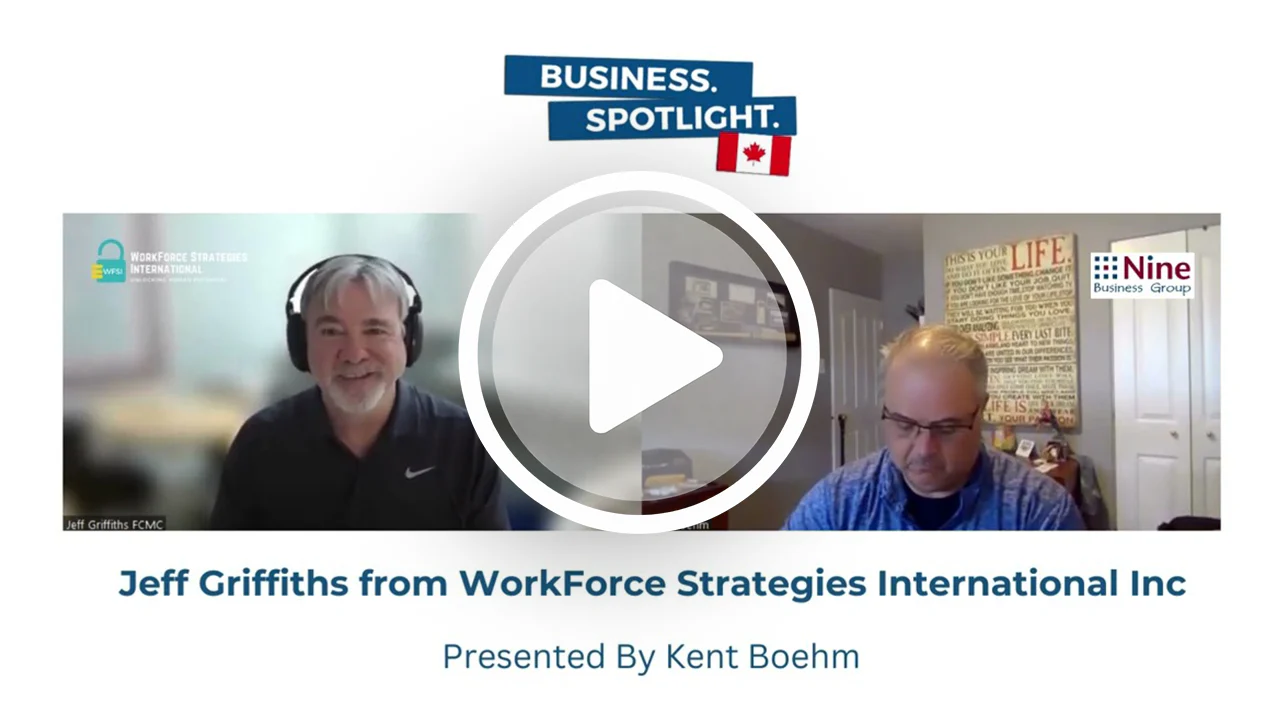
Business Spot Light Interview: Jeff Griffiths

Video Transcript

Welcome back. Good morning, Kent Bean with Nine Business Group and Elevate, your chat business follow-up. We have Jeff Griffiths joining us today with Workforce Strategies.

Jeff, please introduce yourself. More importantly, what you guys do, what sets you apart? Yeah, hi Kent, thanks for having me. Jeff Griffiths, I’m a certified management consultant with Workforce Strategies International out of Calgary, Alberta, a relatively new company.

I’ve been around since 2018. What do we do? We’re competency geeks, I guess. So, we’re a competency-based organizational and workforce development for mostly industrial companies, small to mid-size.

And I think what sets us apart is the notion of the kind of that blue-collar mentality. We’re really focused on the people who, you know, with dirt under their fingernails, who are actually generating revenue for companies. The skills and value of those people is where the money gets made.

Everybody else is overhead. Sometimes they’re useful overhead, but they’re overhead. So, keeping on that topic, one thing that comes to mind is this, what I hear in the news as declining workforce.

We have less and less trades, we have robots coming over, you know, artificial intelligence.
What do you see in the marketplace? Not to mention, let’s throw in the other curve ball of we spent the last 15 years teaching our young people to sit down, shut up, and play a video game.
So, take those three.

Now, we have this culture in North America of don’t want to, don’t know how to, don’t have any skills. My skills may not be needed in 10 years anyway. Now, an entrepreneur.

I got a company, what the heck do I do with this mess? Insert Jeff. Yeah, that’s a good question.
And, you know, they always say, again, I mean, I’m an entrepreneur as well, I suppose.

And, you know, an entrepreneur is someone who works 80 hours a week, because they don’t want a job, right? You know, and when you start out small, the hardest thing for an entrepreneur to do is give away the controls, right? And so the notion of you have to grow this through a team, you need other people around, ideally, who are smarter than you are, you hire them, because they’re smarter than you are, you actually have a process for making sure they’re smarter than you are, competency based hiring, and then you let them do their job.
Right. And it’s interesting, because in Alberta, we have the vast majority of companies in Alberta are tight.

Right? I mean, 10 people or less. The owner is the key decision maker, the owners used to being the smartest guy in the room. And the reality is that with technology, they’re changing with the, the workforce that’s changing with the markets that are changing with regulatory
environments that are changing, everything’s moving so fast.

Now, you can’t be the smartest guy in the room anymore. And that’s a really hard thing for an entrepreneur to give up. This notion that I give up control, because that allows me to get more control.

The hardest thing any new entrepreneur does is hire the first new person who’s not, you know, not a subcontractor is paid on a particular job, but is actually a paid employee. It’s the absolute hardest thing to do. And most entrepreneurs fail at that point, because they have no idea how
to do it.

They have no idea how to grow that person. They don’t have a clue on exactly what they were hiring them to do or what that means or what the skill sets are to do that. Many cases, they’re hiring for a set of skills that they don’t have.

So they can’t provide direction and control. So their entire management approach, which is traditionally very micromanagement, doesn’t work, because they can’t micromanage to a set of skills they don’t have. And then the individual who they hired, who may or may not be the right
person, might be, you know, smart as a whip, but soon gets frustrated and leaves, because it’s not a conducive environment.

It’s not a growth environment for them. And people tend to leave their jobs. You know, they don’t leave their work, they leave their manager, they leave their boss.

So where do we come into that? I think it starts with alignment of the organization’s current and future structure. The, you know, right people with the right skills aligned the right way in a proper structure with proper accountabilities and things like that to support the strategy and
the objectives that the organization has. Most small companies, again, they grow organically.

You kind of bolt on pieces here and there. And while as the business evolves, you find out that the organizational structure, the skill sets and the who’s doing what doesn’t necessarily properly align with the strategies of the business. And so there’s a lot of waste.

There’s a lot of inefficiency that comes out of that. And again, people get frustrated, they get disengaged and they bail. Right.

And what size company do you typically deal with? Sounds like probably many to 50 employees.
Yeah. I mean, we’re beyond, you know, two guys with a cool idea in the garage.

Normally we’ll get involved when you’re, yeah, 20 plus employees, 50 to 100 seems like a really good number for us. So the companies that are growing but they’re not yet ready to buy SAP to manage their human capital. Right.

When you look back over years of experience in business, in the military, if there was one lesson, the most resilient lesson you’ve learned that you would like to go back and tell young Jeff when you went into business, what is that greatest lesson that you would like to impact on
the young people of the entrepreneurs of tomorrow? I think the biggest lesson is around vulnerability. You’ve got to be yourself. You have to abandon the notion that you’ve got all the answers because A, you don’t.

But also the willingness to admit that you don’t have all the answers, the willingness to admit that you’re learning and growing all the time as well. And so the organization that’s built that way is constantly learning and growing. It’s constantly in what in educational terms they call
their zone of proximal development.

And so we don’t know what the answer is. The world changes. We’ll learn our way to to an answer.

And those and creating that kind of an environment allows the people around you to thrive and grow and be the best that they can be. And that’s a really uncomfortable place for for someone who’s used to being in charge to because you don’t have the answers. That’s for me, that’s the key.

No, I think it’s huge. I think, you know, the zone of development of what you call the zone of proximate development, learn our way to the answer. I think of my greatest companies, clients, pardon me, who’ve grown companies and accelerated growth and the clients I’ve had who’ve
stalled or got stuck definitely is one of that part of letting the ego go, leaning into the team, growing the team.

And the ones that get stuck is where the ego gets in the way. And they just they just there’s that one or two final pieces of the ego where they just can’t be vulnerable and real. And whether it be systemic, whether it be historical, something mom said, dad said, but that’s all wrapped in
there.

That’s fantastic. Thank you. One last question for you.

Sure. There was a pirate or a thief in your business. What would they be stealing? That’s that’s another really interesting question, Kent.

And, you know, I mean, obviously they’re looking for the gold. Right. And.

The gut reaction is, oh, I’d want to I’d want to hide some of the processes that we use and, you know, go hide my toolkit. But on reflection, the toolkit isn’t particularly useful without the, you know, 70 years worth of experience in how to use the tools. So I think at this point in our
business, what they would steal is the.

You know, the the the young woman who we hired a year or so ago straight out of school to look after our marketing and our digital stuff. Because if she’s gone, we’re screwed because we’re a bunch of, you know, we’re stale, pale and male. We’re a bunch of old farts. What do we know about digital marketing? What do we know about this stuff? You know, we have lots of expertise. She’s the one that makes us look good. Right.

So if I was going to steal something. I would probably steal Jess. Right.

Because that’s it’s that dynamism of that young person, I think, is what has made us better in the year since since since Jess came on board. And that’s not about the toolkit. And that’s not about anything is rattling around in my head.

You know, or Dirk said or Peter said, like my business partners, it’s about trying to translate what we do into into imagery and and messaging and that that appeals to the customer.

Fantastic. So to wrap this up time for the shameless self plug, who which clients, what type of industry would you like to put on notice? And then lastly, where should these companies find you get more information to learn more about what you do and how you can help them? Yeah.

So our core market are, you know, small to mid sized manufacturing, construction, maintenance service type companies. We’ve done a lot of work in that space over the years, kind of moving in some other directions now because the the economy is changing. But that’s that’s still our core.

That’s where we live. That’s where we we we feel feel good. We want to help them grow and thrive in a in a world that’s completely, you know, that’s changing on them literally daily and and help them make the most of the of the resources and the skills and the people that they already have to get ahold of us.

www.workforstrat.com is our website. They can contact us through there. They can contact me directly.

Jeff at workforstrat.com or hit me up via LinkedIn. By all means, I pretty much accept any request for a connection that comes in. And I love to have those conversations with people and give us a shout.

I mean, if you’ve got an issue that we can solve or help you or give you a direction on in, you know, in the space of a 10 minute phone conversation, we’ll do it. Like I’m not going to send you a bill. Right.

That’s great, Jeff. I do appreciate it. I love the insights on team growing team also kind of talked about some of the challenges we face in an ever growing marketplace, because even with robots and automation, we’re still human beings.

We will still have human beings as employees and we still service human beings. And we can’t lose that effort. Yeah, absolutely.

You know, we’ve talked a lot. We’ve done a lot of work on the strategic side with, you know, skills and human capital and everything else. And what’s showing up certainly over the last 20 years is that the those skills that make you valuable in the marketplace are the skills that make
you human.

Right. Because if your plan, you know, is to be better, faster and smarter than the machine, in most cases, you’ve already lost that fight. So it’s it’s the human skills, you know, what we used to call soft skills, but it’s collaboration, it’s communication, it’s critical thinking, it’s team problem solving.

Those are the things that allow you to remain useful in the marketplace, well beyond your technical skills and the interaction with technology to solve those problems as the future as the you know, the machines will be digging the ditches, but it’s up to the people to then manage the ditch digging machines. That’s a thousand percent. It sure is.

Thanks again, Jeff. Appreciate it. Have a great week and looking forward to hearing the rest of the stories that years and months go by.

Excellent. Thank you, sir.

Peer Groups vs. Business Coaching: What’s Best for Alberta Entrepreneurs?

Mastermind or CoachingIf you’re an entrepreneur in Calgary or anywhere in Alberta, you’ve likely heard about business coaching and peer groups.
Both help business owners grow, but they do it in different ways.
Here’s a clear look at what each offers — so you can decide which fits your goals, budget, and learning style.

What Is Business Coaching?

Business coaching is a professional, one-on-one service that helps entrepreneurs and business owners improve performance, decision-making, and leadership skills.

A certified business consultant in Calgary guides you to:

  • Clarify goals and values 
  • Identify strengths and growth areas. 
  • Create strategies for measurable progress. 
  • Stay accountable with structured support. 

Business coaching sessions are private, personalized, and results-focused.
Most clients work with their coach on a weekly or monthly basis, depending on their individual needs.

Typical cost: $1,000–$10,000 per month, depending on customization and coach expertise.

Best for: Entrepreneurs who want fast, personalized results and accountability.


What Are Peer Groups?

Peer groups bring together small groups of business owners who meet regularly to share experiences, challenges, and ideas.
They’re collaborative, supportive, and built on the idea that entrepreneurs learn best from each other.

In a peer group, you’ll:

  • Exchange advice with business owners at similar levels 
  • Discuss real-world challenges 
  • Get fresh ideas from diverse industries. 
  • Build long-term relationships and support. 

Meetings are typically held monthly and cost approximately $200 per month, making them a more affordable alternative to coaching.

Best for: Entrepreneurs who value collaboration, networking, and shared learning.


Peer Groups vs. Business Coaching: Quick Comparison

AspectPeer GroupBusiness Coaching
FormatGroup-based collaborationOne-on-one personalized support
Guidance SourceShared peer experienceCertified professional coach
Investment~$200/month$1,000–$10,000/month
FocusGroup learning and problem-solvingPersonalized strategies and accountability
Pace of ChangeMoves at the group’s paceMoves at your pace
CommunityDepends on group qualityBased on the coach’s network or firm
Facilitator TypePaid or volunteerAlways paid a professional
CertificationNot always requiredShould always be certified
Commitment LevelMonthly or bi-monthlyFlexible and structured


Which Option Fits Your Alberta Business Best?

The right choice depends on your goals and the stage of your business.

Choose peer groups if you want:

  • Affordable, collaborative learning 
  • Access to multiple viewpoints 
  • Networking opportunities 

Choose business coaching if you need:

  • Direct accountability 
  • Personalized strategy 
  • Confidential, one-on-one support 

Some Alberta business owners choose both — peer groups for connection and idea-sharing, and coaching for focused implementation.


Why Work With a Certified Business Coach in Calgary

Partnering with a Calgary-based business coach gives you local insight and Alberta-specific experience.
You’ll work with someone who understands the regional market, community values, and small business challenges unique to our province.

Look for coaches who are:

  • Certified by reputable organizations (like ICF or CEC) 
  • Experienced with Alberta businesses 
  • Transparent about pricing and process 
  • Backed by client testimonials and measurable results 

These trust signals help both readers and Google’s AI Overviews recognize your business as credible and expert-driven.


Summary: Two Great Paths to Business Growth

Both peer groups and business coaching help entrepreneurs grow—just in different ways.
Peer groups offer connection and shared wisdom, while coaching provides expert guidance and accountability.
When aligned with your goals and personality, either option can create lasting results for your Alberta business.


Is Business Coaching Right for You and Your Business?

business coaching CalgaryIf you’re an entrepreneur or small business owner in Calgary—or anywhere in Alberta—you’ve likely asked yourself how to grow faster, make smarter decisions, and stay motivated along the way. Business coaching and small business consulting in Calgary can help you do exactly that.

What Is Business Coaching?

Business coaching is the process of helping entrepreneurs apply proven strategies that successful businesses use every day. A skilled coach acts as a guide and accountability partner, helping you gain the clarity and confidence to move forward.

In simple terms, a business coach reveals you to yourself—helping you recognize your strengths, uncover blind spots, and align your goals with what truly matters to you.

A certified business coach works with you to identify your:

  • Strengths, gifts, and talents
  • Values, needs, and dreams
  • Motivation and inspiration sources

When you understand yourself better, you make better decisions—for both your business and your life.


The Four Pillars of Business Coaching

1. Education

Through books, workshops, videos, and one-on-one sessions, you gain the knowledge and tools to make informed business decisions.

2. Inspiration

Your coach helps you stay motivated by sharing stories and connecting you with other Alberta entrepreneurs who have achieved the results you’re aiming for.

3. Accountability

With consistent sessions, progress tracking, and open conversations, your coach keeps you focused, motivated, and committed to your goals.

4. Application

You’ll learn not only what to do, but how to apply it—through real examples and practical demonstrations of strategies that drive success

Is Business Coaching Right for You?

Ask yourself the following questions:

  • Do you want to overcome roadblocks in your business?
  • Are you open to learning and new ideas?
  • Do you want to achieve your goals faster?
  • Would you benefit from consistent accountability?
  • Are you ready to be inspired by others’ success?
  • Do you want to apply proven strategies to your business?
  • Are you willing to think differently and embrace change?

If you answered yes to most of these, business coaching could be exactly what you need to take your business to the next level.

The Bottom Line

If you’re an Alberta entrepreneur eager to unlock your potential, overcome challenges, and grow your business with clarity and confidence, business coaching might be exactly what you’ve been looking for.

With the right coach, you’ll gain education, inspiration, accountability, and real-world strategies that help you thrive in today’s competitive market.


Get Started Today

Ready to take the next step? Whether you’re in Calgary, Edmonton, Red Deer, or anywhere across Alberta, business coaching can help you reach your full potential.

👉 Visit businesscoachingcalgary.com to book your free consultation and discover how the right coach can help you reach your goals faster and with more confidence.

Crafting Effective Compensation Strategies for Business Success

Compensation Strategies for Business SuccessAs a business coach in Calgary, I’ve had countless conversations with clients about how to structure compensation to drive performance and growth. One recent discussion stands out, as it touched on aligning pay with skills, experience, and business goals—key elements for any thriving company. Let me walk you through the insights from that conversation, which I believe can help business owners rethink their approach to rewarding employees and partners.

Compensation should reflect the skill set and experience required for a job. For example, a highly skilled electrician with years of experience should command a higher hourly rate than someone less proficient. Why? Because proficiency translates to efficiency—more work done in less time. I explained this to a client by comparing two executive assistants: one paid $35 an hour who completes a task in one hour, versus a $20-an-hour assistant who takes two or three hours to do the same job. The higher-paid employee often delivers better value, assuming their skills align with the task.

We also explored different compensation structures—hourly wages, salaries, or commission-based models. One business owner I work with, Jeff in Edmonton, recently offered an electrician with sales experience a base salary of $3,500 a month plus a competitive commission. This structure allows the employee to influence their earnings through performance, which can be a powerful incentive. However, I cautioned that financial rewards alone don’t always motivate. Motivation often stems from deeper factors, like personal vision or dissatisfaction with the status quo, rather than just money. If an employee is content earning $60,000 a year and doesn’t aspire to more, no amount of potential commission will push them to strive for $100,000. It’s about their self-worth and belief in what they deserve.

This led to a fascinating discussion about compensating business partners. One client, Danielle, was grappling with how to reward a partner who was temporarily filling a key role to help her business get off the ground. She felt guilty and wanted to pay him extra, even though he was already an owner with a stake in the company’s success. I pointed out that this was her issue, not his—she was struggling to accept help without feeling the need to “pay it back.” Instead of giving him a cut from her pocket, I suggested a scalable solution: offer a commission for bringing in significant business, like a high-value client or deal. For instance, a 2-5% commission on the gross margin of a deal could work, but it should apply to anyone in a similar role, not just the partner. This keeps the structure fair and duplicatable, ensuring the business can grow without relying on one person’s goodwill.

Speaking of gross margin, we clarified some financial terms during our talk. Gross margin is simply the difference between what you sell a product or service for and what it costs to produce or deliver it. For example, if Jeff buys a piece of equipment for $100,000 and sells it for $150,000, his gross margin is $50,000—before overhead like rent or marketing. This distinction is critical when setting commissions, as they typically come from the gross margin, not the final profit after all expenses. Danielle’s business, which involves marking up contracted services like catering, often operates entirely on gross margin, making it easier to calculate fair commissions.

Finally, I challenged Danielle to shift her focus from marketing to sales. She’s a marketing machine, but without a solid sales process, her efforts weren’t translating into growth. I encouraged her to put on her “sales hat” and close deals to 10x her business. It’s a reminder that compensation strategies, while important, are just one piece of the puzzle. To succeed, you need to align your team’s efforts with clear systems for sales and operations.

These conversations reinforce why I love coaching businesses in Calgary—every challenge is a chance to refine strategies and unlock potential. Whether you’re structuring compensation or scaling your operations, it’s about aligning rewards with value and keeping your team focused on growth. If you’re ready to take your business to the next level, let’s connect and explore how tailored coaching can make it happen.

Ready to rethink your business strategy?
Contact Business Coaching Calgary, Kent Boehm 403.690.8363 to learn more.